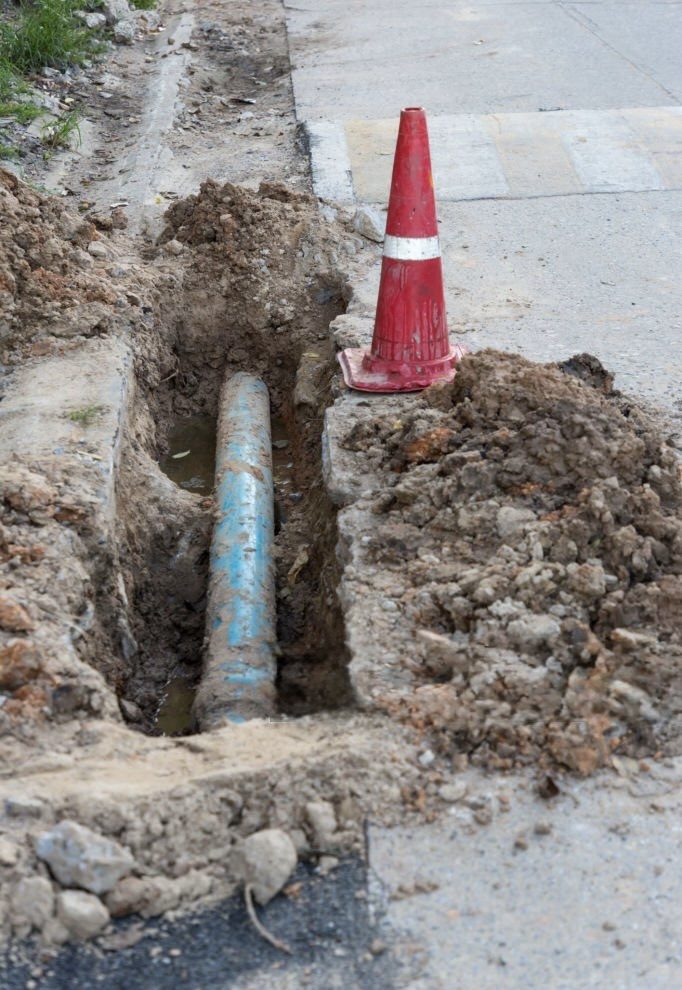
The pipe under the public parkway is yours. Most homeowners find that out the hard way.
The lateral runs from your house to the city’s main in the street, and the whole length of it is your financial responsibility, including the part buried under the public parkway and sidewalk that you do not own and cannot build on. There is no LA city program that covers it. When it fails, the bill is yours, all of it. That single fact is the most expensive surprise in this whole business.
Knowing how the permitting works is how you avoid the second surprise on top of it.
Where your responsibility actually ends
Your lateral ties into the city main, usually out in the street. Everything from your house to that connection point is yours to maintain and repair, parkway portion included. The city owns the main and nothing on your side of it. People assume the property line is the boundary. It is not. The boundary is the main, which can be a good fifteen or twenty feet past the property line.
What the sewer permit covers
Any lateral repair or replacement in LA requires a permit pulled with the city, and the work gets inspected. That permit is what certifies the new pipe was installed to code and connected properly. It protects you, because an unpermitted sewer job is a problem you will inherit the moment you try to sell. We pull the permit and schedule the inspection as part of the job, not as an afterthought.
When you also need an encroachment permit
If the work extends into the public right of way, the stretch from your property line out to the main, that is a second permit, an encroachment permit from the Bureau of Engineering. It covers working in the public roadway and parkway. It adds time and cost, and it is non-negotiable when the failure is out there. You will know up front whether your line reaches the right of way, because it changes the whole shape of the job.
Why permitted work protects your resale
An unpermitted sewer replacement looks like a saving until you sell. A buyer’s inspector or the city can flag work with no permit on record, and then you are redoing or retroactively permitting a finished job under deadline pressure in escrow. The permit is cheap insurance against that. Anyone offering to skip it to save you a few dollars is handing you a future problem.
How permitting affects your timeline
A straightforward lateral repair on your own property permits quickly. Anything reaching the right of way takes longer because a second agency is involved and the roadway work has to be scheduled and inspected. If your failure is out near the main, build that extra time into your expectations. It is the city’s clock, not the contractor’s.
What to ask before you hire anyone
Three questions. Will you pull the permit, or am I. Does this job reach the public right of way, and if so is the encroachment permit included. Will there be an inspection on record when it is done. A contractor who answers those cleanly is one who plans to do the job properly. A vague answer on any of them is your warning. Pair this with the cost guide and you can read a quote completely.
What this usually looks like
A homeowner in Jefferson Park whose backup turned out to be a collapsed clay section right under the parkway, eight feet past the property line. The repair itself was routine. The surprise was learning that stretch was entirely theirs and that the work needed an encroachment permit before anyone could touch the roadway. Right-of-way failures like that, where the bad pipe sits in the public strip the owner assumed was the city’s, are some of the most common sticker-shock calls we get.
Get a straight answer
Tell us your neighborhood and roughly where the trouble is, and we can usually say whether the right of way is in play. Book an inspection and the locate will show exactly where your failure sits relative to the property line and the main, usually within one business day.
Related reading
- What sewer replacement costs in Los Angeles
- Repair or replace your sewer line: how we decide
- Trenchless sewer replacement, explained
- Why LA sewer lines fail