Tell me the year your house was built and I can usually guess how its sewer will fail.
That is not a party trick. LA sewer lines fail in a small number of ways, and which one is coming for your line is mostly decided by when the house went up and what the lateral was made of. Four failure modes cover almost everything we see. Knowing which one you have is the same as knowing the fix.
One: clay joints let go
Most LA homes built before about 1960 have vitrified clay laterals. Clay was a reasonable material for its day and was built to last roughly fifty years, which for a lot of these houses ran out decades ago. The weakness was never the pipe, it was the design. Clay comes in short segments with a joint between each one, and as the ground settles those joints separate. Once a joint opens, it leaks, and roots follow the water in. This is the single most common failure under the older central neighborhoods.
Two: cast iron rots from the inside
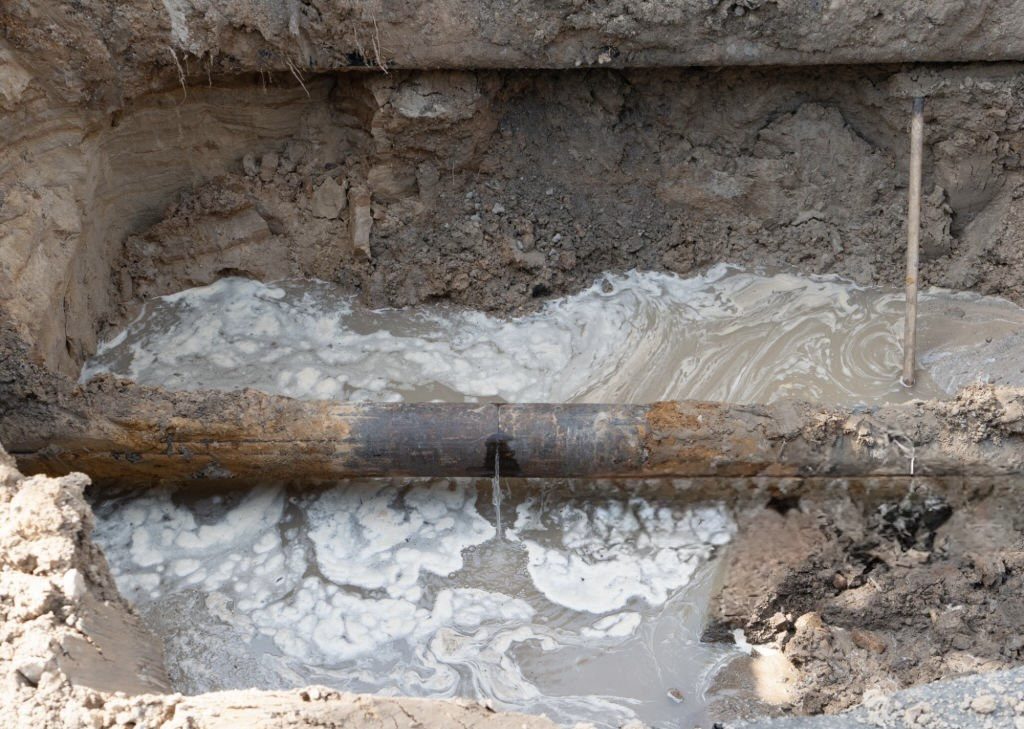
Homes from roughly the 1940s through the 1960s often have cast iron, at least for the stretch near the house. Cast iron does not fail at joints. It corrodes along its whole length, decade by decade, as wastewater eats the pipe wall and scale builds up inside until the channel narrows and the bottom rots through. Because the failure is spread along the pipe rather than at one point, a single patch on a corroded cast iron line rarely holds. The next failure is already forming a few feet away.
Three: roots, which are really a joint problem
Roots get blamed as if trees attack pipes. They do not. A root grows toward the moisture seeping from a joint that has already separated, slips through the existing gap, and thrives in the water inside. The root mass is the symptom you see on camera. The open joint is the cause. That is why clearing roots without closing the joint just resets the clock, a cycle covered in the root and hydro jetting guide.
Four: the ground itself moves
A large share of LA homes sit on slopes, and hillside soil does not hold still. It creeps downhill under its own weight and shifts suddenly in a quake. A rigid clay or cast iron pipe in moving soil pulls apart at its joints, and on a steep lot the segments offset sideways as well. This is why two identical houses, one flat and one on a hillside, fail differently. The flat one fails from age. The hillside one fails from age and motion both, often sooner.
How the cause points to the fix
Each failure has a matching repair. A separated clay joint with sound pipe around it gets a spot repair or a sectional liner. A pipe leaking at many joints but still round gets a full liner. Corroded cast iron or a collapsed line gets replaced, usually by bursting. A hillside line that has shifted sideways sometimes has to be dug, because no-dig methods need a pipe that still runs true. Match the method to the failure and you do not overpay. The decision logic is laid out in the repair or replace guide.
Why your home’s age is the first question we ask
A 1928 house in Hancock Park almost certainly has original clay and will fail at the joints. A 1952 house in the Valley likely has cast iron near the house and will corrode. A 1925 bungalow clinging to a hillside in Echo Park has clay and ground movement working on it together. The age and the location narrow the failure mode before a camera ever goes in the line, which is why we ask. It is also why a contractor who quotes without knowing either is guessing.
Get a straight answer
Tell us the era of your home and your neighborhood and we can usually name the likely failure before we see it. Then a camera confirms it. Book an inspection and you will know which of the four you are dealing with, usually within one business day.
Related reading
- Repair or replace your sewer line: how we decide
- Root intrusion and hydro jetting
- Trenchless sewer replacement, explained
- Sewer camera inspection: see the footage first